A side project, a year-old domain, and a problem nobody had solved yet.
I’ve been a software engineer for over a decade. I tinker for a living and for fun — there’s always a new side project, a new agent, a new workflow I’m pushing a little further than the one before it.
Last year I was setting up an autonomous agent for one of my side businesses. I’d spent months refining a set of skills on my laptop — code review, debugging, deployment, the rituals you only stop noticing once they’re sharp. To get the agent useful, I copy-pasted those skills into a second environment. Then I spun up a third agent and did it again.
And it hit me: every time I refined one of these skills — which I’d do constantly, because that’s how skills get good — I’d have to propagate the update by hand to every machine and every agent that used it. Forever.
I don’t like maintenance work. I like to push forward, learn the next thing, ship something new. The thought of spending the next year of side projects fighting a copy-paste treadmill was unacceptable.
So I bought botdocs.ai. And then I sat on it.
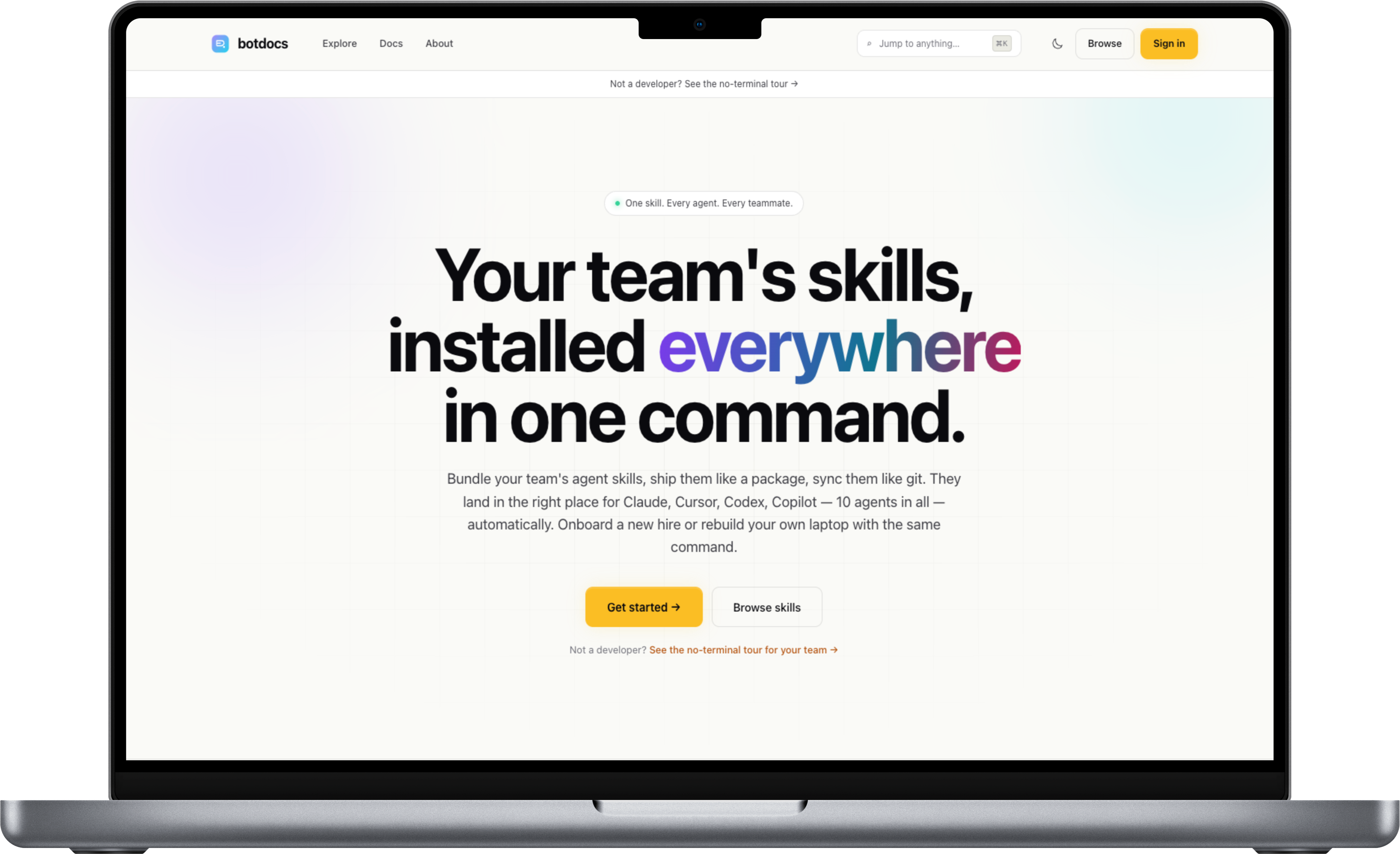
The domain lived in my registrar for a year before I wrote a line of code. I had the conviction that this would matter, but I wanted to be sure I wasn’t solving a problem only I had. So I watched. I scrolled X. I lurked on Reddit. Three or four threads later — engineers asking the same question, nobody offering a real answer — I knew. I started building.
Don’t pick a side too early
There’s a pattern I see almost everywhere I look in this space: teams picking a side too early.
Cursor, Claude, ChatGPT, Codex — and whatever launches next month — every one of them is shipping fast, competing on price and quality, and asking you to build your workflow inside their walls. That’s reasonable for them. It’s risky for you.
The waters are still blue. The winners haven’t emerged. Locking your skills, your workflows, and your team’s muscle memory into a single provider today is locking yourself into a maintenance burden tomorrow — and a switching cost when the wave changes. Which it will.
The right thing to bet on isn’t a provider. It’s a portable layer above them. A skill you write once that runs identically in every agent — not just copied, but translated so it actually behaves the same in Claude Code, Cursor, and Codex. So you can ride whichever wave is working best for you, this month, without rebuilding from scratch.
That’s what Botdocs is. Your team’s shared library for agent skills — write a skill once, and it runs identically in Claude Code, Cursor, Codex, and Copilot.
The team version is worse
Now picture three teammates on three different platforms. One works in Cursor. Another lives in Claude Code. A third is on Codex. You write your team’s code-review style up as a skill and ship it around — pin it in Slack, drop a zip in a Drive folder, email a markdown file to the new hire. Plenty of teams work this way today. It works for about a week.
Then the skill evolves. The senior engineer sharpens the wording. Someone catches an edge case in the debugging ritual. The “always check this before shipping” list grows a new bullet. And now you’re back at the start — re-pinning the new version, re-emailing the new zip, hoping everyone notices, hoping nobody is still running last month’s copy on a build that ships tomorrow.
The first share is the easy part. Keeping everyone on the latest and greatest as the skill keeps improving is the part nobody has solved. Without it, the shared muscle memory that makes a team faster than the sum of its individuals drifts — across people, across providers, across machines. Behavioral drift, with nobody minding the gap.
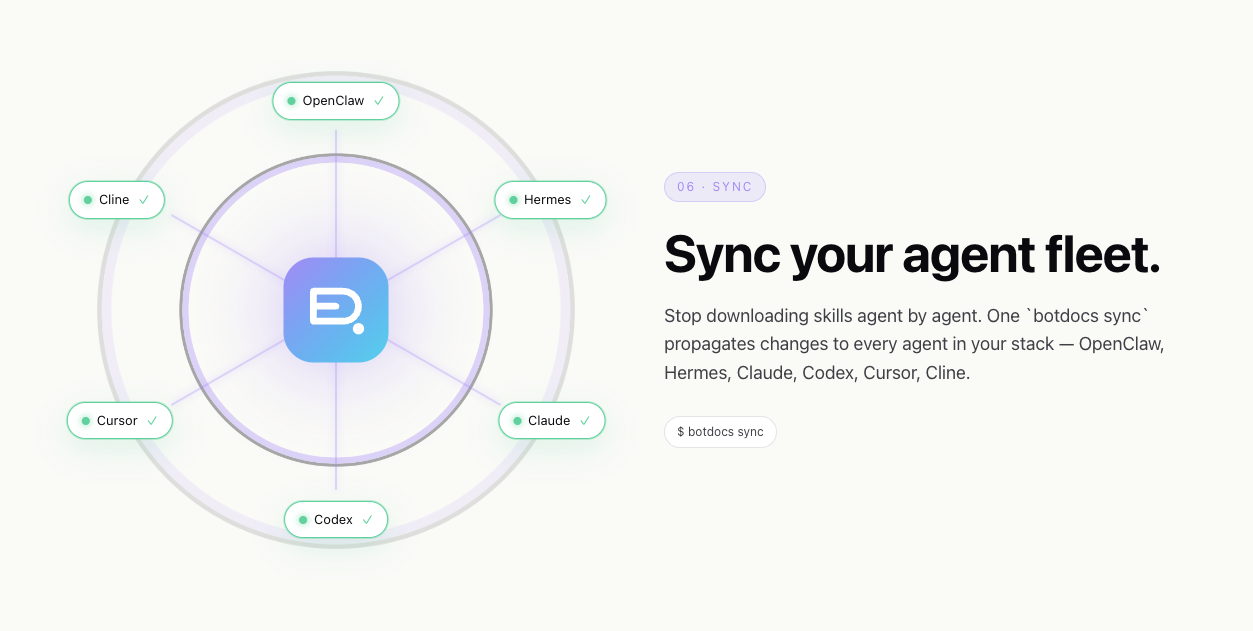
Botdocs solves that. Publish a skill to your team and it propagates. And it doesn’t just copy the file — it translates the skill so it behaves the same whether your teammate runs Claude Code, Cursor, or Copilot. A new hire signs in and gets every skill on day one. When you refine the skill — and you will, constantly — a single sync rolls the update out to every teammate’s machine and every agent they run. The unit of distribution is the team, not the machine. The latest version is the version everyone has.
What changed for me
I’m Botdocs’ power user number one. Everything I built I built because I needed it for my own setup first.
It used to be a late-night project to roll out a refined skill across all my agents. Now it’s a single command. I refine skills ten times more often because the cost of doing it dropped by ninety percent. That compounds.
The maintenance burden didn’t disappear — it just moved into a place where the work I do once propagates everywhere. Which means I get to spend the time I save on the part of building I actually enjoy: tinkering, trying the next thing, pushing the agents I run a little further than they were yesterday.
If this is your problem too
Right now Botdocs is one engineer’s solution to one engineer’s problem, shipped in the open because I’m pretty sure it’s everyone’s problem too.
If you’ve been copy-pasting the same skill into Cursor, then into Claude Code, then into a Codex agent — or watching your team’s conventions drift across three providers and four machines — Botdocs was built for you.
You can browse what’s there at botdocs.ai. Write a skill once. Run it in Claude Code, Cursor, Codex, and Copilot. Publish in five minutes. Install in less. And the next time you spin up a new agent, you’ll thank past-you for not having to do it the hard way.